VIRLab EgoShift WACV 2027, Evaluation & Datasets

EgoShift

A benchmark for egocentric spatial updating

Only Task B states an action, so only there can the wording give the answer away. EgoShift computes how far that goes — 45.90%, fixed by the camera geometry before any model ran — and holds all ten turn cells to it.

  • A Is this the same object? control
  • B Where is it after you turn? primary
  • C Can you still see it, or is it hidden?

Task B — where the failure is

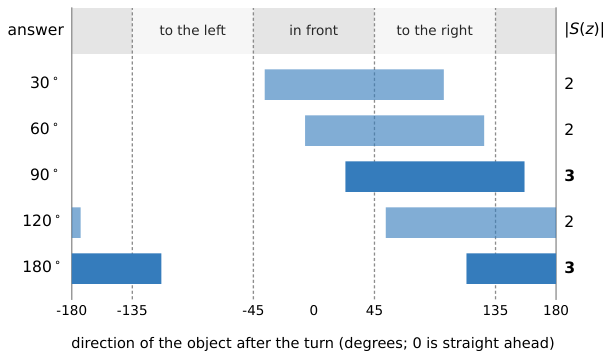
Which answers the stated turn leaves reachable in front right behind left

the turn leaves 3 of 4 answers reachable

turn alone, no image 33.3
12 frontier configs, mean 38.3

At 90° the twelve frontier configurations average +5.0 over what the stated turn alone reaches. None of them exceeds 50%.

What EgoShift measures

A teapot sits on the table in front of you. Turn 90° to the right and it is on your left — the teapot has not moved, you have. Robots and augmented-reality assistants do this constantly, and they must also tell whether an object has left the camera's view or is hidden behind something else. EgoShift puts that to vision–language models in simulated indoor rooms, one stated turn at a time.

12,786held-out questions
8,198distinct rooms, none in two splits
15,761development questions, answers released
36systems evaluated
27trained-annotator sessions
45.90%what the stated turn alone reaches
Task A

Is it the same object?

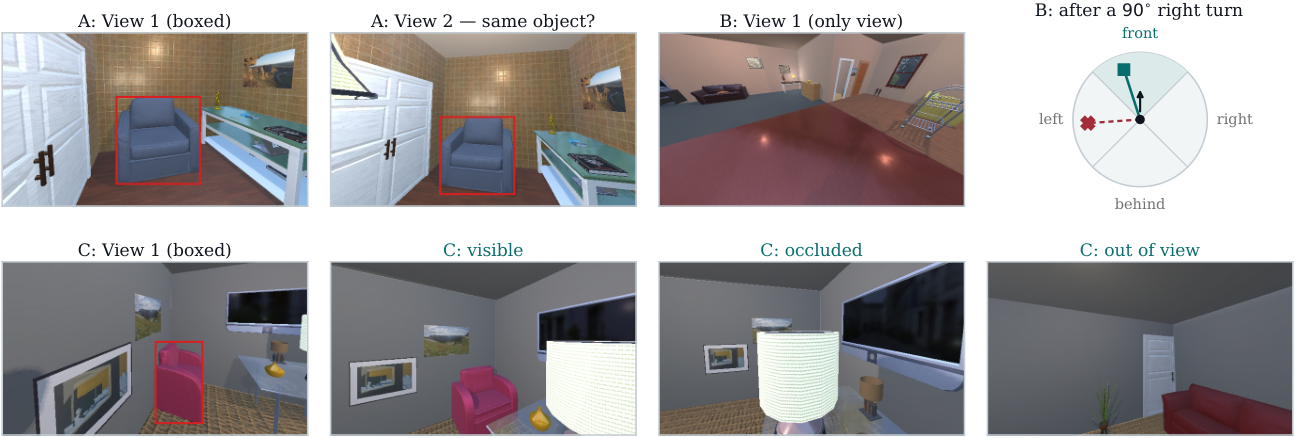
Two views of one room, a box drawn in each. A control, provisional, and no difficulty claim rests on it.

5,838 questions
Task B — primary

Where is it after you turn?

One view and a stated in-place turn, never the view afterwards. The only task whose question names an action.

1,098 questions
Task C

Can you still see it?

Visible, out of view, or occluded, after the camera has moved. Matched triples, one question per answer.

5,850 questions

Task C, switched live

The first view boxes the target. Pick what happens next — each is a real second view from the same room.

The chair is still drawn in the second view, so the answer is visible.
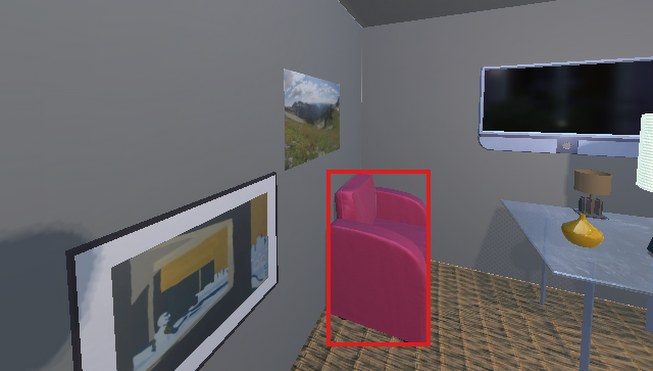
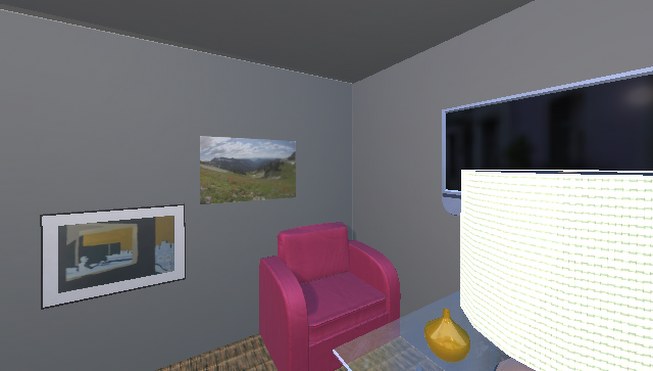
First view of a grey-walled lounge. A pink armchair is marked with a red box, beside a framed picture and a television.
View 1 — target boxed
Second view of the same lounge: the pink armchair is still drawn.
View 2 — visible
Eight example panels from EgoShift showing the three tasks: cross-view object matching, direction after a stated 90 degree turn on a compass dial, and the three visibility classes.
Examples from the development split. Rooms are generated with AI2-THOR and ProcTHOR and rendered at 640×480. The red rectangle marks the object in question. On the Task-B dial, teal is the correct answer and red is what a model gets by assuming the object started straight ahead.

What the three tasks show

Each task answers a different question and the three are never combined into one score. Two of them come out well, and they are what make the third one readable.

Task A — control

Is it the same object?

96.6%strongest of 36 systems

Models find a boxed object and match it across two views under this renderer. That is the whole job of a control: a low Task-B score cannot be blamed on the imagery. The task carries no difficulty claim of its own, and it is provisional.

Blinded. With both images withheld the twelve frontier configurations average 46.1% against a 50.0% random rate, and none exceeds 53.3%. One view alone leaves the open models at the chance rate.

Task B — primary

Where is it after you turn?

83.6%strongest; frontier spread 42.0–83.6%

Pooled, this reads as nearly matching the trained panel's 84.6%. Read one turn at a time, it splits in two: high at 30°, 60° and 120°, and down at the action-only bound at 90° and 180°. The rest of this page is about that split.

Blinded. All twelve frontier configurations score 42.5 to 44.2%, mean 43.4% — this subset's action-only bound. A spread of 1.7 points across twelve systems makes that a property of the questions, not of any model.

Task C

Can you still see it?

89.3%strongest of 36 systems

The difficulty sits in the occluded class, not in visible or out of view. The best model reaches 88.0% on occluded questions, above the trained panel's 74.4%, so the human number is not treated as a bound there either. Every target appears once with each answer, so recalling an object's usual answer scores one in three.

Blinded. 29.7% against a 33.3% random rate, and no system exceeds 35.8%. A model cannot answer Tasks A and C from the wording or a single view.

Tasks A and C state no action, so no stated turn can narrow their answers; the answer balancing described further down protects them instead. Only Task B names an action, which is why only Task B has a bound to be read against — and why the sections that follow are about what happens there.

Difficulty does not grow with the turn

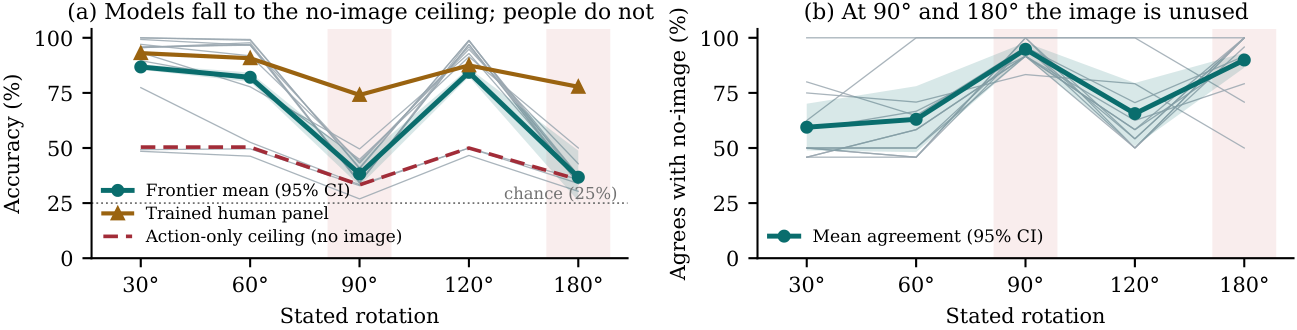
Task-B accuracy is high at 30°, 60° and 120° and drops sharply at 90° and 180°. A 120° turn is answered correctly more than twice as often as a 90° one, so a pooled score hides the difference.

30°
+36.4mean 86.8 against 50.4
2 answers reachable
60°
+31.7mean 82.1 against 50.4
2 answers reachable
90°
+5.0mean 38.3 against 33.3
3 answers reachable
120°
+34.3mean 84.3 against 50.0
2 answers reachable
180°
+1.1mean 36.8 against 35.7
3 answers reachable

what the stated turn alone reaches mean of twelve frontier configurations

The 95% scene-clustered bootstrap intervals over 2,000 draws are [85.5, 88.1] at 30°, [80.0, 84.3] at 60°, [32.8, 44.1] at 90°, [82.3, 86.3] at 120° and [25.9, 48.8] at 180°. The 120° and 90° intervals do not overlap. The 180° cell holds 56 questions, so the two hard turns are also reported together: 38.0% over 290 questions, interval [32.9, 43.1].

One rule covers almost every frontier error

The failure is not many different spatial mistakes. It is one mistake made repeatedly, and it is specific enough to state in a sentence.

The straight-ahead rule. The model ignores where the target actually is, assumes it lies straight ahead, and then applies the stated turn correctly.

It matches 98.7% of Claude Opus 5's answers at 90° and 100.0% at 180°, while agreeing with the correct answer only about a third of the time there. Counting every frontier mistake, it alone accounts for 82.0% of 3,670 errors, and for 86.9 to 100.0% of the errors made by the eight strongest configurations.

A simpler account — that these models never update at all — does not fit. A model answering in the un-rotated starting frame would score 25.0%, and that rule matches what the models said on only 27 to 33% of 90° questions. The pattern fits a rotation applied to an assumed direction rather than to the one in the picture.

The wrong axis, chosen by the turn

100.0% against 1.3%

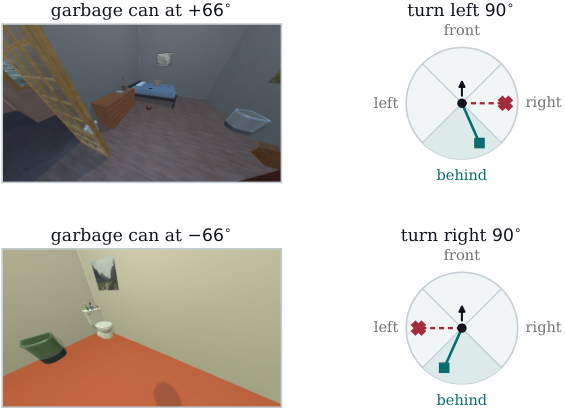
At 90° Claude Opus 5 answers every to the left and to the right question correctly, against 1.3% of in front and 2.6% of behind. At 180° the pattern reverses. The stated turn decides which axis is wrong.

The image stops changing the answer

94.8% against 59–66%

Each model is compared with its own no-image answer on identical questions. The two agree on 59.4%, 63.0% and 65.6% at 30°, 60° and 120° — against 94.8% at 90° and 89.9% at 180°, over 24 questions per turn per model, intervals [91.3, 97.9] and [86.5, 93.2]. Neither model ranking nor question difficulty explains the gap, because this compares a model with itself.

More reasoning does not help

−0.9 to −7.1

Three configurations ran at a raised reasoning setting against their own default. All three score lower at 90° and 180°, even where the pooled score rises. The extra computation goes to the turns where the failure is not.

A mirrored pair of Task-B questions. In each, the correct answer and the answer obtained by assuming the object started straight ahead are marked on a compass dial.
The same substitution on a mirrored pair. There are 127 held-out questions at 90° and 180° where the five strongest configurations all give the straight-ahead answer.

What this does not settle. The straight-ahead rule is an interpretation of the evidence, not an established mechanism. Three tests converge on it, but the matched counterfactuals that would settle it — varying the stated turn while holding the picture fixed — have not been run. A model behaving this way for another reason would produce the same evidence.

Try it yourself

Real questions from the development split, all three tasks, drawn at random and never ending. You get exactly what the model gets. On Task B no box is drawn on the object, because the benchmark draws none.

Task B — primary

People find those turns harder too, and never fall that far

Nine paid lab annotators per task returned 27 sessions, scoring 98.1%, 84.6% and 89.6% on the three tasks, with Fleiss' κ of 0.960, 0.681 and 0.820. Their accuracy drops at the same two turns, so part of the difficulty belongs to the questions rather than to the models. It never approaches the no-image score.

30°
turn alone50.4
frontier mean86.8
trained panel93.1
90°
turn alone33.3
frontier mean38.3
trained panel74.1
180°
turn alone35.7
frontier mean36.8
trained panel77.8

The pooled score makes the two look level

On the pooled Task-B number the best configuration reaches 83.6% against a trained-human mean of 84.6%. Read one turn at a time and the two stop matching: the best model beats the panel by 6.9, 8.6 and 11.4 percentage points at 30°, 60° and 120°, and trails it by 24.5 and 27.8 at 90° and 180°.

Raters stay 41 to 42 percentage points above the action-only bound at both hard turns. The model mean comes within 5.0 percentage points of it at 90° and within 1.1 at 180°.

Two plots: Task-B accuracy against stated rotation, and the percentage of answers identical to the same model's no-image answer.
Models fall to the no-image score at 90° and 180°; people do not.

How to read the human number. This is a trained-human reference, never a human ceiling. It estimates what a trained panel does on these questions, not a bound on what people can do, and three departures from the written protocol limit it further. On the 120 shared questions the panel tied or disagreed with the simulator on four Task-B and ten Task-C questions; setting those aside raises rater accuracy from 84.6 to 86.3% and from 89.6 to 94.8%, so the gap reported here is the conservative one. The institution's review board determined before collection that the study does not constitute human subjects research requiring oversight.

Leaderboard

Task B is the primary task. Task A is a provisional control. Sort by any column.

Model
1Gemini 3 Pro (thinking)91.483.688.0
2Gemini 3 Flash96.683.589.3
3Gemini 3 Pro91.881.988.2
4Claude Fable 594.881.488.4
5GPT-5.6 Sol (thinking)93.281.188.0
6Claude Opus 5 (extended)95.180.284.3
7Claude Opus 591.680.183.2
8Claude Sonnet 592.677.175.8
9GPT-5.6 Sol93.476.387.2
10InternVL3-38B96.165.165.2
11InternVL3-78B91.956.163.6
12Gemini 3 Flash Lite96.253.067.3
Trained human panel 98.184.689.6
Action-only bound (Task B only) —45.9—
Random rate 50.025.033.3

Task A is scored on a fixed 1,192-question subset, Task B on its complete 1,098-question held-out set, and Task C on a 1,200-question subset drawn as whole matched triples. Only Task B states an action, so only Task B has an action-only bound; for Tasks A and C the reference is the random rate. The three tasks are never combined into one score.

Why you can believe the finding

A question that states how far the camera turned can be answered from that turn alone, with no image. EgoShift computes what that is worth — from camera geometry, before any model runs — and holds every turn to that floor, so a score can be read against what the question gave away.

Where the bound comes from

Every Task-B image is taken at standing height with a fixed tilt and field of view, and the stated turn is a rotation about the vertical axis from that same spot. Only the heading changes, so the set of answers a turn can produce is finite and can be computed exactly.

The construction requires the object's centre to start within 66.5868° of straight ahead — the horizontal half-angle of a 640×480 frame at a 120° vertical field of view, written into the build before any pose was replayed. Two independent implementations agree on all ten turn cells, and the held-out set meets the bound in every one, holding the shortcut to 45.90%.

Why balancing is not enough

An earlier build passed every conventional balance check, yet a system that saw only the stated turn scored 72.3%. The imbalance that matters sits inside individual turn cells, not across the question set. That build differs from the released one in other ways, so the number shows what the test catches, not a controlled measure of what the construction changed.

The recipe is not specific to EgoShift. Any benchmark whose questions state an action can compute the score reachable from that action alone, and build against it before balancing.

Diagram showing, for each stated turn, the band of directions the object can occupy afterwards and how many of the four answers that band covers.
A turn shifts the whole band of starting directions around the circle. The band covers three answers only at 90° and 180°; a larger turn does not widen it, so a larger turn is not a harder question.

What the bound covers. Exactly one shortcut: answering from the stated turn with no image. A build that meets it has shown nothing about wording, metadata, or a cue that some future model finds and we did not anticipate. Learned attacks on the questions are a separate check, with a protocol fixed in advance and not yet run.

Scope and limits

What the benchmark does not establish, stated plainly, because a result is only as useful as the conditions it was measured under.

Simulated rooms only

Every scene is rendered in AI2-THOR at one resolution and one field of view. There is no photorealism, no sensor noise, no pitch change and no multi-step navigation. Nothing here shows the results transfer to natural images or to a robot.

One action family

The only action a question states is an in-place turn about the vertical axis. Object categories follow the AI2-THOR asset library, so neither the objects nor the layouts represent real interiors.

One shortcut bounded

The bound covers answering from the stated turn with no image, and nothing else. We do not claim the questions are free of shortcuts in general.

The rule is an interpretation

Three tests converge on the straight-ahead rule, but the matched counterfactuals that would settle it have not been run. A model behaving this way for another reason would produce the same evidence.

A small trained panel

Nine paid lab annotators per task, not a population sample. The reference estimates trained task performance, not a bound on what people can do, and three departures from the written protocol limit it further. No rater demographics were collected, so we cannot say how representative it is.

Not a random sample of systems

The 36 systems were chosen, not sampled, so comparisons between them are descriptive. Task A is a control, carries no difficulty claim, and is provisional.

Run it

The public artifact holds the questions for every split, the development answers, the construction and audit tools, and every raw model response behind the paper's tables. A reader can recompute the numbers instead of trusting them. Only the held-out answer key is withheld, which keeps the benchmark usable as a test.

git clone https://github.com/UTSA-VIRLab/EgoShift.git
cd EgoShift && pip install -e ".[full]"
egoshift audit-taskb --questions taskb_questions.jsonl

If you report results

@inproceedings{ahmed2027egoshift,
  title     = {EgoShift: Bounding the Action-Only Shortcut in Egocentric
               Spatial Updating for Vision-Language Models},
  author    = {Ahmed, Faisal and Quarles, John and Desai, Kevin},
  booktitle = {Proceedings of the IEEE/CVF Winter Conference on
               Applications of Computer Vision (WACV)},
  year      = {2027}
}